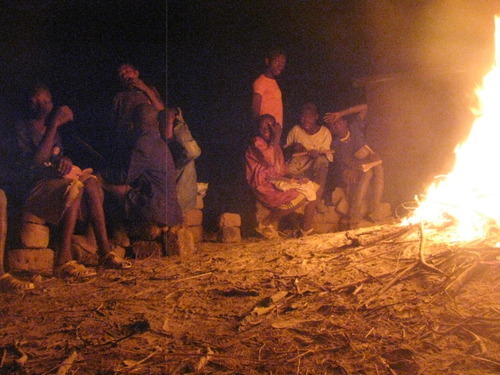
I usually wake up around 5 am. Unless I remember to put in my
earplugs, or I happen to sleep through the Morning Prayer. It is amplified on
the only electronic device I know of in the village other than flashlights, and
the mosque is not far from my house, my host dad being the Imam and the village
being very small.
Then I fall back to sleep immediately, and wake up again at about
6:15, at which point I either a) Go on a run, or b) roll back over for another
hour. If I choose option (a) I get to see the beauty of the forest and fields
at dawn, when the sun is but a gentle and tender golden orb, and the mist rises
serenely in the morning silence. But this is rare, for I normally choose option
(b) and fall back asleep.
Activity in my compound begins around 6:30 or so when one or more
host moms rises to start pounding corn. After this point, babies start to cry,
kids get up and start yelling, and animals (Cows, donkeys, goats, sheep, chickens,
dogs etc.), who never really stop making noise during the night start making
even more noise. By around 7:15 the compound is crazy, and I am roused one last
time from my slumber. The space of the compound is shared with something like
35 people, and by 7:30 the chaos has usually reached the plateau that it stays
at for most of the day.
 |
| A typical compound scene |
Sometimes, after getting up I will try to make coffee, on wood
flame[1],
or eat a Kola nut, but usually I drink a bunch of water, and a shot of
delicious Kedougou honey, bought at the market for $4 a liter.
Breakfast is invariably ‘koojio’, viscous corn porridge of sorts with
a good bit of sugar. It is quite good. I would not, however, object to a bit of
variation. This meal is eaten in the front room of my host dad's hut, unlike
lunch and dinner, which we eat in the shaded courtyard of the
mosque. Along with my host dad, we eat meals with one of his sons, and a
shifting mix of Talibé students
and young men who are Koranic teachers in training.
I do not yet understand how it is determined who eats with us. It
is an ongoing game of musical chairs-- except without chairs, since we eat in a
squatting position on the ground/floor. We use deep spoons to slurp up Koojio,
the only utensil of any kind employed throughout the day’s meals.
Women and men never eat together. When female volunteers visit for lunch they stay back and eat with the women and kids in my compound, while I go with
the men to the Mosque. That's just how it is.
 |
| The women's/children's bowl |
Women make food magically appear wherever we are about
to eat it. I almost never notice the bowl(s) arriving at the mosque or host dad’s,
and my host mom is gone before I knew she had arrived.
After breakfast I pack my daypack, brush my teeth, take my malaria
pill, and go find a garden to work in.
During my first couple months in site, I have had two main work
sites. Things are quickly diversifying as I get more established in the
community, but thus far work has been straightforward.
One is a little garden next to the 'forage' (water pump,
installed by the government) that I have been re-establishing after a season of unruly fallow. Now that it is established, all that I do most
mornings is water. Village kids often wander to the garden, and seeing me
working, want to help. They find me to be hilarious and interesting.
When this began, I was happy to have the kids participate. But
was still protective of my work.
 |
| Clearing out the space with Douwa, who is terrific, and whose name means 'prayer' |
I found both of these scenarios to be less than ideal, but I did not know what to do until
one day on a bike ride I had the idea to give
the garden to the kids. This way I could reduce my own concern with the
situation, and hopefully inspire a little bit of responsibility through
ownership.
A brilliant idea, I thought.
So, I announced that very evening that the garden was now the ‘kid’s
garden’
(Dindingolu laa sardingé,
in Jaxanké) and tried to
make sure the kids understood. I appointed my host brother, Bassiru, who is
nine, cool, and helpful, to head up the project. I told the kids that I would
keep doing things there, but that I wanted them to initiate the daily
watering.
The idea garnered with almost zero enthusiasm from the kids. I had imagined that they would be thrilled and enthusiastically claim the space as their
own, but instead this garnered nothing more than apathetic sighs of acceptance.
I pressed the idea anyway, and would remind the kids in the
morning and the evening that they should go water their garden. I also
tried discussing with them things that they wanted to do, asking, “Is
there anything in specific you would
like to grow?”
Nada.
They cared very little for the role of proprietor. They continued
to water for a while, but enthusiasm waned quickly until one day Bassiru actually
just said 'No, we aren't going to water,' with a smile and waggle of the head
as if he were declining a second helping of mashed potatoes. Totally inoffensive.
Just an honest declination. They simply didn't want to do it.
 |
| Young Bassirou unenthusiastically waters a young Banana |
This didn't bother me—I never pressed the kids to do anything in anything other than a casual way— but I was perplexed. Why were these kids unwilling to water?
They had been so enthusiastic about helping at first!
I didn’t leave when they were watering. I was still there, tending
to other tasks, so we were still working together. They were still helping the
toubab!
But, that wasn't it. I was missing something.
Then one day I began rereading The Adventures of Tom Sawyer.
When I got to the second chapter, Strong Temptations, about the white
picket fence, I had to laugh at myself.
Mark Twain, reflecting on a situation not unlike my own,
recognizes and extracts a universal lesson of human nature in this archetypical
story of human behavior.
In Strong Temptations, Tom wants to play outside. It is a
nice day and he has fun plans, but his aunt tells him that he’s
got to paint the fence first. To deal with this situation he cleverly
manipulates his playmates’ perception of work and play by
charismatically portraying the task as fun. His peers then come to covet the
chore, and actually trade him apples and other trinkets in exchange for the privilege to paint the fence.
 |
| A skilled Marketer |
The job remains the same. All that changes is the framing, which
then alters how the job is perceived.
I realized that what I was experiencing here was the inverse of this story. The children here enjoyed playing with me
while I worked. As long was it was my project, they were carelessly tagging
along and what they were doing was not work, even if they were helping me work. However, when I made them
responsible, it became work, and suddenly not fun.
Good literature, I suspect, is a teacher for all times and
places.
At this point my task is to find a way to reframe helping me as
epic fun.
Needless to say, the 'children's' garden is not my top priority.
It is fun, and a social work environment, but the main project is the Master Farm.
Generally, Mamadou, my master farmer, has long since watered everything and is busy
with some kind of task when I get out to the farm. The
diligence, strength, effectiveness, and knowledgeability of his work as a
farmer is truly impressive. He is an deeply religious man[2]. He rises with the first prayer calls of the morning at 5
am and begins preparing himself for the day. In the evenings he often lays out
a canvas sack or whatever he has on hand and performs the 4:00 and 7:00 prayers
in the Master Farm.
He is also, for me, one of the most comprehensible people in the
village. This is in large part because of his extremely cool, unhurried manner,
and slow, clear speech, as well as our common ground as gardeners/farmers. When
going in to the Peace Corps, I knew that I would learn more than I would or could ever teach. However I never expected how drastically true that
would be. Until this point, between Mamadou and I, the flow of information has
been virtually all in one direction.
But it is much more than farming techniques/facts that I have
been learning from this man-- the greatest and most profound thing that I am learning from Mamadou is about the spirit of an African subsistence farmer. His
outlook, and attitude towards things is, I want to say, fundamentally different
than anyone I have ever gotten to know. He seems to have a total affinity with the
land, and is calm and thoughtful in his actions and affairs. He carries out
his tasks as a farmer with an inspired harmony with the space and things around
him. In his presence I feel a calmness and peace that I cannot honestly equate
to anything I've known before.
 |
| Mamadou, who has never heard, or heard of 2Pac |
Mamadou is a man with only limited formal education of any kind-- Koranic school. Thus
his spirit and mind have been cultivated in a way that is not possible through
any institution.
If I can find the words I would like to elaborate on this.
Ours is a relationship of relatively few words, but mutually
understood silences.
The work on the MF is, so far, my primary effort with regards to
the first goal of the Peace Corps.[3]
I enjoy most every aspect of the MF work; my agency in the planning and
execution of projects, the collaboration with Mamadou, other Darou Salaamians,
and the Peace Corps, and the work itself, which is quite interesting,
challenging, and strenuous.
Most of all I think I like it because every bit of work I do--
every shovel full of dirt I lift, every time I swing a pick and every bucket of
water I pull out of the well-- is a contribution to a tangible end, much of
which I am able to admire with time. There is a very real telos with the work,
as the space improves, I get to enjoy it. I will someday literally enjoy the
fruits of my labor.
These days, there are two main tasks that occupy a good chunk of
my time on the farm. Watering, and digging beds.
Watering:
Southern Kedougou gets slightly more rain in an average year than Portland, Oregon; almost 7 feet a year.
 |
| Skewed |
That is a lot of water. The issue is
that it all falls within 5.5 months, and 3/4ths of it within 3 months. So it
comes hard and fast. Thus it is extremely hard to manage and inevitably leads to
flooding and erosion. This is not ideal for
agriculture.
And when the rain stops it is followed by 7 months
of heat and total dryness. Most of the verdure does not last more than a month after the rains stop, so Kedougou quickly transforms from a land of lush verdure to an extremely dry landscape of parched, cracked, white earth.
So water becomes this divine life-giving force
that is miraculous and fleeting. If you want anything to survive through the dry season you have to just dump it on, day in and day out. Thus, as the garden expands, pulling water from the well has come to occupy a large chunk of time every morning and evening.
Digging beds:
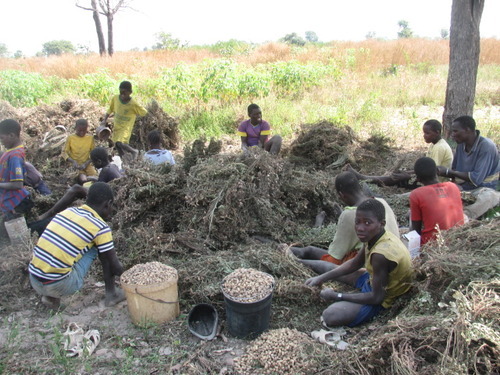
The land that is now the Master Farm has been used to grow peanuts for many years. When these are harvested in the ‘traditional’[4] way, the entire plant is pulled out of the ground, and fed to animals, or just left in a pile to dry out/rot. This means that the nutrients of the plant, which is in fact a nitrogen fixing legume, are not recycled back into the earth at all. Over many years this practice can leach the soil of nutrients, and reduce the land to hard, pale earth. Because of this, it takes a lot of work to get the land into vegetable-growing shape.
The land that is now the Master Farm has been used to grow peanuts for many years. When these are harvested in the ‘traditional’[4] way, the entire plant is pulled out of the ground, and fed to animals, or just left in a pile to dry out/rot. This means that the nutrients of the plant, which is in fact a nitrogen fixing legume, are not recycled back into the earth at all. Over many years this practice can leach the soil of nutrients, and reduce the land to hard, pale earth. Because of this, it takes a lot of work to get the land into vegetable-growing shape.
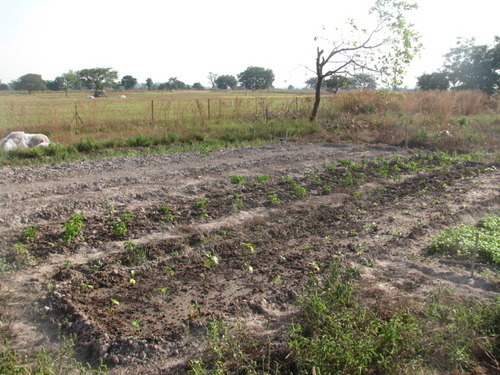
We start this process by watering sections of the farm we want to
dig. This loosens the land up a little. Then it becomes a matter of elbow
grease. First you hit the whole area with a pick, then double dig it to add amendments,
and shape it into a bed. It is a long process, but I will not bore you with
more details.
 |
| Mamadou placing tree sacks in our nursery |
There are a great number of other agricultural tasks that Mamadou
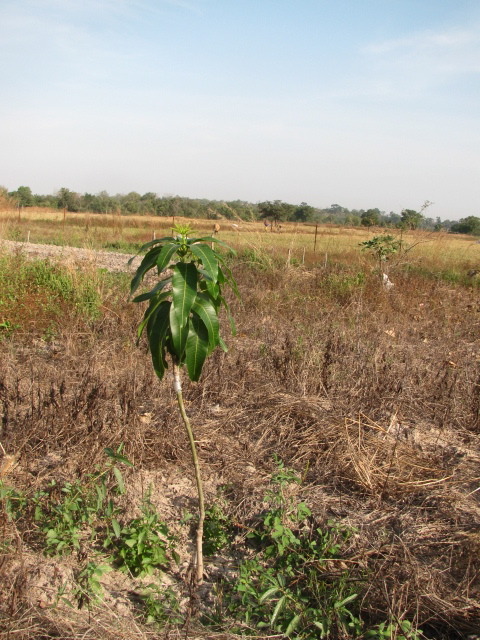
and I attend to on the MF. We mix sand and manure together and plant tree
seeds in this mix in plastic sacks. We add mulch to beds, transplant things from
nurseries, clear brush, seed new nurseries, etc. I will never want for lack of
tasks on the MF.
Of course my ultimate job is not to simply grow eggplants and mangos on a Master Farm. It is to
inspire other people to do so, and show them how to do so 'better'. This is the real challenge of PC work; moving from straightforward Agricultural
work, which I know and love, to larger scale work of education, and
technique/seed extension. The MF is very important, either way, as a demonstration space for the techniques and varieties that are
intended to help improve agricultural practices in my village. I am focusing on
creating a thriving gardening space so that I can gain
credibility in the eyes of my fellow villagers, and inspire them to consider new practices.
If it is not intensely hot, (a relative term) Mamadou and I may well work straight through the morning and into the early
afternoon. I drink the water straight out of the well on the farm.
It is sweet, cool, and hasn't gotten me sick once. This also
allows me to stay out there for extended periods of time.
 |
| Where I read |
 |
| My Crew |
So any time I come and kick back in my compound I am generally
swarmed by children who I adore. But I can only do so much of this, so I will
very often retire into my hut for a time while waiting for lunch and drink chia
seeds and read.
 |
| Where I sleep |
That gets me to lunch on a typical day. Obviously though there is no
such thing as a typical day, and my life changes with time and with the seasons. The onset of hot season will be sure to change things. During this period of
time a large part of my job will just be staying alive. It has already gotten to 110 in
Tamba, just north of Kedougou. The hot season is worst between April and early
June. It is approaching fast. I plan on swimming in whatever is left of the
Gambia River as much as possible, and doing anything that needs to be done very
early in the day.
Anyway, I will leave it there for now.
[1] As with the whole village; to my
knowledge there are no gas stoves in Darou Salaam. I went to buy a little one
to facilitate personal cooking but the dispensary had gas canisters available
for exchange only. Compressed natural gas seems to be in short supply in
Kedougou.
[2]
Indeed the Jaxankés are known and renown throughout west Africa as especially
devoted Muslims.
[3] Which reads: “To help the people of interested
countries in meeting their need for trained men and women.”
[4]
I use scare quotes here because the peanut was introduced to (read ‘forced
onto’) the Senegalese by the French. It is native to what is now Paraguay. So
any ‘tradition’ is a relatively new one.